

9 Untold Tales of Krishna

Krishna, the beloved deity of Hindu mythology, is a figure of profound wisdom, endless charm, and divine mischief. We are discussing 9 untold tales of Krishna.
His stories have been passed down through generations, captivating the hearts of devotees.
Here, we explore some lesser-known yet fascinating tales of Krishna, shedding light on his multidimensional personality and the deeper lessons they offer.
Table of Contents
Krishna’s Disguise as a Girl: A Mother’s Protective Love
In the idyllic village of Gokul, young Krishna was the apple of Yashoda’s eye, yet a constant target for the malevolent Kansa. To protect him from Kansa’s persistent attempts to harm him, Yashoda often dressed Krishna as a girl.
Adorned in beautiful frocks, jewelry, and a bindi, Krishna’s disguise was meant to confuse any demonic forces sent by Kansa. This tradition, deeply rooted in folklore, symbolizes a mother’s boundless love and her ingenious ways to shield her child from harm.
This age-old practice reflects the deep connection between divine protection and maternal instincts, a testament to the lengths a mother will go to protect her child.
Read More: The Tragic Death of Karna in the Mahabharata
Krishna’s Generosity: Butter for the Monkeys
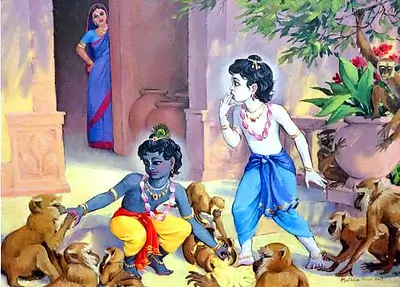
Krishna’s childhood is dotted with delightful tales of stealing butter, earning him the endearing title of “Makhan Chor.” However, Krishna was not merely a mischievous butter thief; he was a generous soul.
After stealing butter, Krishna would share it with the monkeys of Gokul, remembering their ancestors’ loyalty to him in his previous incarnation as Rama. This act of sharing butter was Krishna’s way of expressing gratitude to the monkeys, who had assisted Rama in rescuing Sita.
This story not only highlights Krishna’s playful nature but also his profound sense of gratitude and his understanding of karmic balance.
Krishna’s Training and the Ultimate Guru Dakshina
Krishna and Balram’s formative years were spent under the tutelage of Sage Sandipani in Ujjain. After completing their education, Krishna asked Sandipani for his Guru Dakshina. The sage requested Krishna to bring back his son, who had been taken by the ocean.
Krishna, accompanied by Balram, ventured into the depths of the sea and confronted the demon Shankhasur, who had captured many souls. After a fierce battle, Krishna defeated Shankhasur and rescued Sandipani’s son, fulfilling his promise.
This story exemplifies Krishna’s unwavering dedication to his teachers and the profound respect for the guru-shishya (teacher-student) tradition.
Read More: Why do Hindus Avoid Meat in Shrawan?
Krishna and Balram: The Divine Siblings
In their celestial origins, Sheshnag, the divine serpent, felt slighted in his role as Lakshmana during the Ramayana. Vishnu, understanding this, promised a reversal of roles in their next incarnation. Thus, Sheshnag was born as Balram, the elder brother, while Vishnu incarnated as Krishna.
This reversal allowed Balram to guide and protect Krishna, fulfilling a cosmic balance. Balram’s strong, steady nature complemented Krishna’s strategic brilliance, forming a dynamic duo that faced numerous challenges together.
This divine sibling relationship underscores the importance of role reversals and the balance of power in cosmic play.
The First Description of Krishna: A Legacy in Words and Art
The earliest description of Krishna’s physical form comes from Uttara, the wife of Abhimanyu. She detailed Krishna’s enchanting features: his lotus-like eyes, mesmerizing smile, and radiant blue complexion.
Inspired by her words, Krishna’s great-grandson, Vajranabh, sculpted Krishna’s image, ensuring that future generations could visualize his divine beauty. This description became the foundation for Krishna’s iconography, immortalizing his image in art and scripture.
Vajranabh’s sculptures ensured that Krishna’s divine form remained etched in the hearts and minds of his devotees, creating a lasting legacy.
Krishna’s Dual Nature: Gentle Lover and Fearsome Warrior
Krishna’s personality was a blend of tenderness and strength. With the Gopis, he was the epitome of love, enchanting them with his flute and playful antics.
Yet, on the battlefield, his demeanor transformed into that of a fierce warrior.
This duality is best exemplified in the Mahabharata, where Krishna, as Arjuna’s charioteer, displayed unparalleled strategic acumen and courage.
His ability to embody both gentle and warrior aspects made him a versatile and revered figure, demonstrating that true divinity encompasses all facets of existence.
Krishna’s Humility: The Healing Dust
Krishna’s life was marked by episodes of profound humility and the depth of his devotees’ love.
Once, when Krishna was severely ill, a physician prescribed the dust from the feet of a loving woman as a cure. Krishna’s wives, despite their love, feared the sin of applying their foot dust on his forehead.
However, the Gopis, with their selfless devotion, readily offered their foot dust, even at the risk of eternal damnation.
This act of pure love and humility cured Krishna, highlighting that true devotion transcends fear and societal norms, embodying the essence of unconditional love and selflessness.
The Legend of Radha: Eternal Love
Radha’s love for Krishna is immortalized in the works of Jayadeva, particularly in “Geet Govind.”
Jayadeva once faced a dilemma while writing about Radha’s reaction to seeing another woman’s hair on Krishna’s shoulder. Struggling with this portrayal, he left the verse incomplete. Legend says that Krishna himself, taking Jayadeva’s form, completed the verse, demonstrating his divine intervention.
This story underscores the deep bond between Radha and Krishna, a bond that transcends time and literary tradition.
Radha’s story is a testament to the enduring power of divine love and its timeless impact on literature and devotion.
Krishna as Ranchhod: Strategic Retreat
Krishna’s decision to retreat during the battle with Jarasandh earned him the name “Ranchhod,” meaning “the one who fled the battlefield.”
However, this strategic retreat was not an act of cowardice but wisdom.
By relocating his people to the city of Dwarka, Krishna preserved countless lives and ensured the prosperity of his kingdom.
This act of prudence over valor highlighted that true strength lies in knowing when to fight and when to preserve life. This story, though often misinterpreted, reveals Krishna’s foresight and his commitment to the greater good, showcasing his strategic brilliance.
The tales of Krishna are a treasure trove of wisdom, love, and divine play. These lesser-known stories provide a deeper understanding of his multifaceted personality and the profound lessons embedded in his life.
They remind us of the enduring wisdom, compassion, and strategic brilliance of Krishna, enriching our connection to this beloved deity.
Whether it’s his playful mischief, strategic retreats, or acts of profound humility, Krishna’s stories continue to inspire and captivate, offering timeless lessons for all.
By exploring these untold tales, we gain a richer perspective on Krishna’s divine journey, a journey that continues to illuminate the path of countless devotees.
Disclaimer: I wanted to take a moment to clarify that some of the articles we have written are factually correct, supported by verified data and sources. These articles provide accurate information that our audience can rely on.
However, there are also articles that are based on personal opinions. While these pieces offer valuable insights and perspectives, it's important to recognize that they reflect the views of the authors and may not be universally applicable or agreed upon.